Leave us a message
Should you be interested in our paver block machine, please leave us a message, and we will respond as soon as possible.

In the concrete block manufacturing industry, selecting the suitable concrete block production line is one of the most critical decisions affecting your factory’s footprint, product quality, and initial investment.
While the Legged Pallet (Footed Pallet) System has been a proven, reliable workhorse used successfully by major global manufacturers for decades, many plants also consider the traditional Single Pallet System (flat pallets).
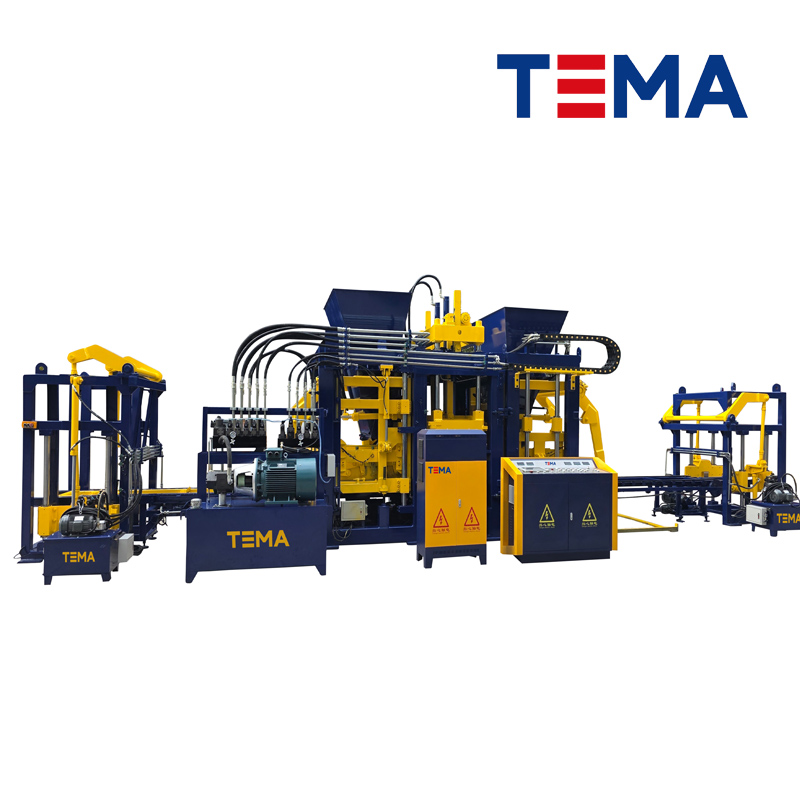
By directly comparing these two established setups, you can easily identify which system aligns with your production goals and financial strategy.
The most common issue in block production is the damage caused to "green" (wet) blocks during the wet block handling.
The Single Pallet Challenge: In entry-level or semi-automated flat singple pallet setups, stacking pallets often puts pressure on the wet blocks underneath, leading to deformation, cracking, and high scrap rates.
The Legged Pallet Advantage: The integrated legs create a fixed, rigid clearance between layers. Because there is no direct contact between the upper pallet and the fresh wet blocks below, the structural integrity and pristine appearance of every block are perfectly preserved.
Land is a premium asset, and how you store blocks during the crucial curing phase dictates your entire factory layout.
The Single Pallet Challenge: Without expensive racking, flat pallets must be spread out horizontally across the factory floor, requiring a massive physical footprint.
The Legged Pallet Advantage: Thanks to the structural support of the pallet legs, blocks can be safely stacked 6 to 8 layers high immediately after production. This vertical consolidation heavily reduces the size of the required curing zone, saving invaluable land resources.
Achieving high-efficiency automation is the goal for any modern concrete paver block plant, but the investment paths between these two systems look entirely different.
The Single Pallet Challenge: To automate a single pallet system with high automation, without damaging the gree blocks, you must invest in complex finger cars, lowerators/elevators, and heavy-duty steel rack curing system.
The Legged Pallet Advantage: Because legged pallets are inherently self-stacking, they enable a fully automated paver block production and curing workflow without the need for expensive, complex steel-structure curing rooms.
Choosing between these two systems ultimately comes down to your financial allocation and factory design:
If your budget is fully sufficient: Investing in a fully automated Single Pallet System with a steel curing room offers the pinnacle of controlled environment curing, high-speed cycling, and long-term durability.
If your budget is limited, but you still require full automation: The Legged Pallet System remains one of the most efficient, practical, and highest-yielding production methods available today. It bridges the gap perfectly, allowing you to achieve high-level automation and space savings without the massive upfront capital required for steel curing kilns.


 English
 français
 русский
 español
 العربية